TOURMALINE
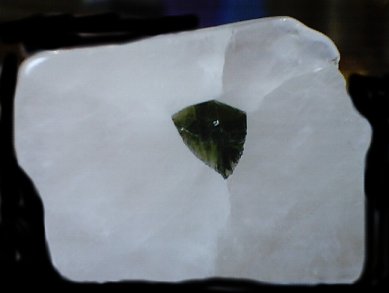
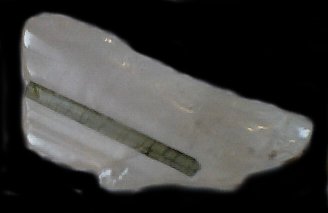
Green Tourmaline "in" Quartz (included)
Tourmalines are a favourite among mineral collectors. Their rich and varied colours can captivate the eye. Even the black opaque tourmalines can shine nicely and produce sharp crystal forms. Tourmalines are cut as precious gems, carved into figurines, cut as cabochons, sliced into cross-sections and natural specimens are enthusiastically added to many rock hound's collections.
rough red tournaline (rubellite) on quartz, much reduced in scale
There are many unique properties of tourmalines. First, they are piezoelectric which means that when a crystal is heated or compressed (or vibrated) a different electrical charge will form at opposite ends of the crystal (an electrical potential). Conversely if an electrical potential is applied to the crystal, it will vibrate. Secondly they are pleochroic which means that the crystal will look darker in color when viewed down the long axis of the crystal than when viewed from the side. This property goes beyond the idea that the crystal is just thicker in that direction. Even equally dimensioned crystals will demonstrate this trait. This property can be used as an advantage by gem cutters who may wish to inhance a crystal's pale colour or weaken a strongly coloured crystal.
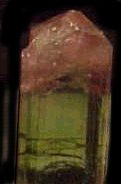
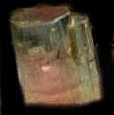
Not sure if this is watermelon tourmaline, but it is certainly bi-coloured of some description. A nice hunk of watermelon tourmaline is way high on my list, btw! :)
Hey! I got some! This is from Afghanistan. It's pale (pastel) but still very pretty. Pity you cannot see, in these pictures, the pink in the centre.
Underneath, is some very nice plain green tourmaline; also from Afghanistan.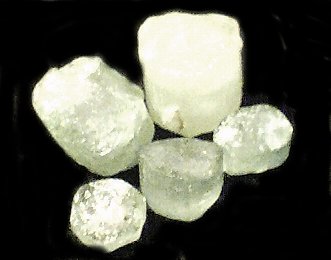
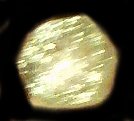

The three main kinds of tourmalines are distinguished by their colour and transparencies. Elbaite is the gemstone tourmaline and comes in many varied and beautiful colours. It is transparent to translucent and is highly prized as minerals specimens and as gemstones. The iron rich schorl is the most abundant tourmaline and is black and opaque. It is a common accessory mineral in igneous rocks and can form nice crystals. Dravite is the least common and forms translucent brown crystals. Some of these crystals are nicely formed and can reach good size.
(The Mineral Gallery)
Hardness: 7 1/2 Other characteristics
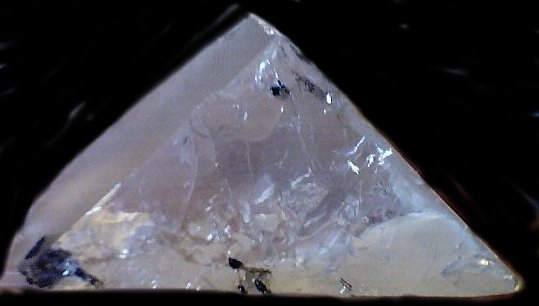
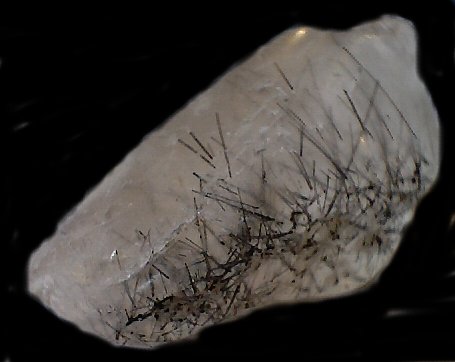
Tourmalated Quartz (see also rutilated quartz)
|
Metaphysical Attributes: Inspiration, understanding, confidence. Balances male/female energies and the mind. Black Tourmaline: Protects against negativity. Encourages intellectual thought, vitality. Corresponds to the root chakra, and the astrological sign of Capricorn. Blue Tourmaline: Communication, psychic awareness. Corresponds to the throat and third-eye chakras, and corresponds to the astrological signs of Libra and Taurus. Green Tourmaline: Creativity, prosperity, abundance. Represents life energy of plants. Excellent for people who work with herbs for healing. Enhances cooperation and healing. Opens the heart chakra, and corresponds to the astrological sign of Capricorn. Rubellite (dark pink) Tourmaline: Creativity, love, devotion. Corresponds to the root and heart chakras, and the astrological signs of Sagittarius and Scorpio. Pink (light) Tourmaline: Love, spirituality, joy, peace, understanding. Corresponds to the heart chakra and crown chakra, and the astrological sign of Libra. Watermelon Tourmaline: Activates the heart chakra, corresponds to the astrological signs of Virgo and Gemini. Super activator of the heart. Augments endocrine glands and metabolism. Balances the emotional system. Dispels fear and negativity; aids in sleep and balance. Fights infectious dis-eases. Has strong electromagnetic properties. It has been used in the treatment of nervousness, disorders of the heart and lungs, and in dysfunctions of the emotional system. |