TURQUOISE
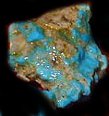 | 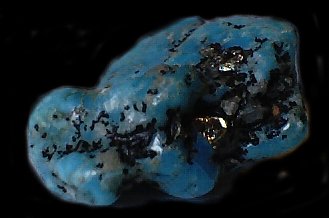 Turquoise from Sonora, Mexico - note the pyrite |
Turquoise is probably the most valuable, non-transparent mineral in the jewelry trade. It was mined by Egyptians on the Sinai Peninsula as early as 6000 BC. and was transported to Europe through Turkey, accounting for its name, which means "Turkish" in French.
Turquoise is hydrated copper and aluminum phosphate -- CuAl6(PO 4)4(OH)8 4H2O -- that is used extensively as a gemstone. It is a secondary mineral deposited from circulating waters, occurring exclusively in desert and arid environments. Its appears blue to green, with waxy veins in aluminum-rich, volcanic or sedimentary rocks.
Turquoise is an opaque mineral with a slightly waxy luster, ranging in color from blue through shades of green to yellowish gray. An elegant sky blue, which provides an beautiful contrast with precious metals, is the most valued color for gem purposes. Some collectors prefer turquoise that is delicately veined within a matrix of impurities of limonite or other substances.
Very fine, untreated turquoise is fairly rare. The finest comes from Iran and Tibet, often appearing in a black matrix. Numerous, excellent deposits in the southwestern United States, usually with a white or brown matrix, have been worked for centuries by Native Americans. Turquoise also occurs in northern Africa, Australia, Siberia, China and Europe.
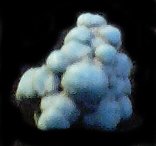
My small blob of Mexican turquoise.
American Indians of Colorado, Arizona, Nevada and New Mexico have long fashioned turquoise into ornamental jewelry, inlays and carvings. The Navaho believe turquoise is a piece of the sky which has fallen to earth. The Apache think it combines the spirits of the sea and sky to helped warriors and hunters aim accurately. The Zuni beleve that turquoise protects them from demons, while the Aztecs reserved turquoise for the gods and was not to be worn by mere mortals. Montezuma's treasure, now displayed in the British Museum in London, includes a carved serpent covered by a mosaic of turquoise.
Because turquoise remains so popular today, much of the mass-market material has been dyed or color stabilized with resins to seal it and to improve color. Turquoise is often imitated by "fakes" such as the mineral chrysocolla.
(My hub has a little nugget in his medicine bag! A crafted fetish creature too! :) (Below))
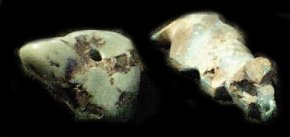
Hardness: 5-6
| Merges the energy of Blue Father Sky to Mother Earth. Strengthens and aligns all chakras, meridians, and subtle bodies. Stimulates the throat, heart, and naval chakras, balancing communication skills and emotional issues. Excellent for spiritual attunement and provides grounding during deep meditations. Brings peace of mind and is a great healer of spirit. Both a protective force and a bestower of goodness. Turquoise helps the ability to express oneself and verbalise freely. It is good for laryngitis and nervousness in speech. It is said that turquoise will grow pale on a sickly person and recover its colour when returned to a healthy person. Can strengthen entire anatomy and helps improve all diseases. Shields the wearer from harmful influences, attracts friendship. Used in meditation. Also for the development of intuition. Brings one wisdom. It reminds us of both our spiritual nature, our earthly inheritance and its beauty. |
From the Aberdeen Bestiary Project
Turquoise brings anger and boldness.