STILBITE
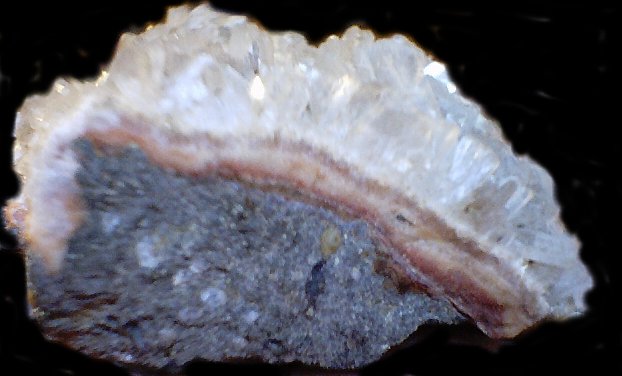
from Moonen Bay, Isle of Skye, Scotland
NaCa2Al5Si13O36 -14H2O, Hydrated sodium calcium aluminum silicate Stilbite is a common and perhaps the most popular zeolite mineral for collectors. Stilbite crystals can aggregate together to form a structure resembling wheat sheafs. This hourglass structure looks like several crystals stacked parallel to each other with the tops and bottoms of this structure fanning out while the middle remains thin. Stilbite's hallmark crystal habit is unique to stilbite and a rarer but related zeolite called stellerite. Whether in the wheat sheafs or not, stilbite can be a hansome specimen with its pearly luster and often colorful pink tints. Stilbite commonly forms nice crystals inside the petrified bubbles (called vesicles) of volcanic rocks that have undergone a small amount of metamorphism.
Stilbite's structure has a typical zeolite openness about it that allows large ions and molecules to reside and actually move around inside the overall framework. The structure contains open channels that allow water and large ions to travel into and out of the crystal structure. The size of these channels controls the size of the molecules or ions and therefore a zeolite like stilbite can act as a chemical sieve. Stilbite's structure contains rings of alumino-silicate tetrahedrons oriented in one direction and this produces the prominant pinacoid faces, the perfect cleavage and the unique luster on those faces.
Hardness: 3.5 - 4

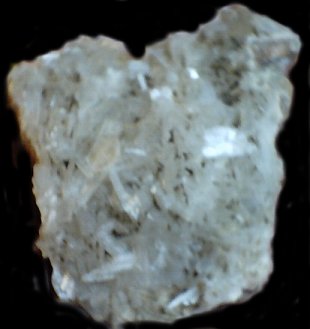
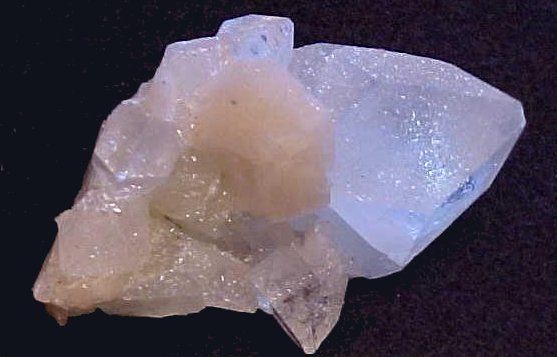
and here's a beaut piece of stilbite on apophyllite from Poona, India. (Apophyllite white; stilbite pink)
Notice the fine coating of druzy quartz sprinkled over it - shiny!
See also Zeolites