SMITHSONITE
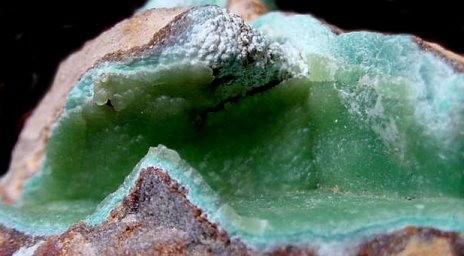
 Blue smithsonite from the Santa Eulalia Mine, Chiuhuahua, Mexico, forming the "cement" of a breccia. Smithsonite is named for James Smithson, the founder of the Smithsonian Institution. The lustre of smithsonite sets it apart from other minerals: it has a silky to pearly luster giving natural specimens a certain play of light across its surface that resembles the fine lustre of melted wax glowing under a candle flame. It is easy to wax poetically when discussing smithsonite's unique lustre. It is really unusual and captivating and collectors can easily get hooked.
Smithsonite, in addition to wonderful lustre also has a varied colour assortment. The apple green to blue-green colour is probably smithsonite's most well known, but it is its purple to lavender colour that is probably its most sought after hue. There also exists attractive yellow, white, tan, brown, blue, orange, peach, colorless, pink and red smithsonite specimens and all of them are a credit to this mineral.
The typical crystal habit of smithsonite is an interesting form called botryoidal. This form has the appearance of grape bunches and is the result of radiating fibrous crystals that form from central attachment points and grow outward and into each other. The result is a rounded, bubbly landscape for which smithsonite is considered the classic example. There are also other habits more typical of Calcite Group minerals including rounded rhombohedrons and scalenohedrons. Most of these come from the famous mines of Tsumeb, Namibia and the Broken Hill Mine in Zambia. The Tsumeb specimens are coloured by trace amounts of cobalt and can have some real exotic colors. The Kelly Mine, Magdalena, New Mexico has produced the absolute finest blue-green botryoidal masses of smithsonite. But there are many localities that have or are producing excellent specimens.
Smithsonite has been and is still being used as an important, although rather minor ore of zinc. At Leadville, Colorado the smithsonite deposits were largely overlooked until their profit potential was finally realised. Many other zinc ore minerals may have been originally smithsonite before metamorphism or other altering processes, formed new minerals. Smithsonite forms in dry climates as a weathering product of primary sulfide zinc ores such as sphalerite.
Hardness: 4-5 Other characteristics.
 |