OBSIDIAN (perlite and Apache Tears)
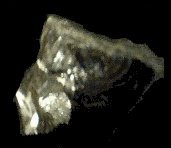
obsidian (from Vesuvius, ossidiana)
Obsidian, a volcanic glass, usually of rhyolitic composition, forms by rapid cooling of a viscous lava. Most obsidians are more than 70 percent silica and are low in volatile contents. Microscopic crystals of quartz or feldspar are sometimes included in the glass. Obsidian occurs as thick, short flows or domes over volcanic vents. It is usually black in colour but occasionally red or brown (if iron-oxide dust is present), clear, or green. Obsidian displays a well developed conchoidal fracture, which makes it an excellent material for arrowheads, knives, and other sharp tools and weapons. Archaeologists use obsidian tools to trace trade routes, because such tools are relatively rare and each occurrence has a slightly different chemical composition. Thus the source of primitive obsidian tools may be located even if the tools have been traded across thousands of kilometers. Obsidian has also been used as a semiprecious gem because of its shiny luster.
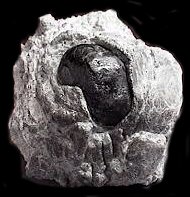
obsidian lodged in perlite - this type being what is known as "apache tears" (I just love this; yes it's mine!)

This "loose" Apache Tear is mine too. From Colorado - a gift from a friend. I hope you can appreciate the transluscence, as I have it held against the light. It's not true about what they say about "never crying again", by the way!
Perlite (above), a hydrous form of obsidian, is used as a lightweight aggregate. An interesting feature which sets perlite apart from other volcanic glasses is that when heated above 870° C, it expands from four to twenty times its original volume due to the presence of combined water in the crude perlite rock. The water vaporizes, creating countless tiny bubbles and perlite 'pops' in a manner similar to popcorn. It can expand up to 20 times it's original volume, accounting for the light weight of expanded perlite. The rounded nodules of obsidian left after hydration and alteration of surrounding material into perlite are known as Apache tears. Looking like black teardrops, they are collector's items in the American Southwest. Now used in rock wool.
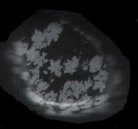
Snowflake Obsidian
Obsidian is a very shiny natural volcanic glass. When obsidian breaks it fractures with a distinct conchoidal fracture. Notice in the photo above how it fractures. Obsidian is produced when lava cools very quickly. The lava cools so quickly that no crystals can form.
When people make glass they melt silica rocks like sand and quartz then cool it rapidly by placing it in water. Obsidian is produced in nature in a similar way. Hardness: 6-7.
| A stone of achievement for those working to a goal in their life. It creates positive influences to overcome problems and provides inner tranquility to ease stress symptoms. An excellent general healer. An excellent grounding and protective energy which shields against negativity. Transmutes negativity into the light and induces creativity. Aids in the removal of disorders of the body. Balances the stomach, entire intestinal tract, and general muscle tissue.
Those who possess an "Apache tear" are said to never cry again! "A telephone line to the soul! This stone connects with the "inner you" and brings out your best attributes. Also develops an affinity with horses." SNOWFLAKE - A grounding stone - make the user face up to responsibility. Dedicated to change, metamorphosis, purification, fulfillment, inner growth and introspection. Deflects negative energy. |