METEORITE
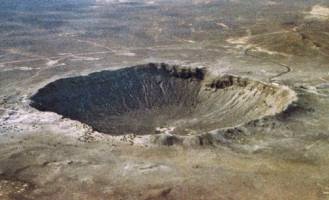
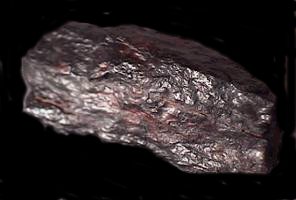
from the Diablo Crater, Arizona
(nickel-iron shrapnel)
Extraterrestrial. Meteorites from Canyon Diablo (Meteor Crater)
Back in the early 1870's someone, perhaps a cattleman passing through looking for rangeland, discovered the crater. The first written account of the crater dates from 1871, but it was known to Native Americans who lived on these plains 900 years ago".
Meteor Crater Official Website
It's very interesting!
"In 1886, shepherds were grazing their flocks near Canyon Diablo. One of them found a piece of iron, and mistaking it for silver, tried to sell it. He wasn't successful. In 1891, a prospector wandered into the area and saw the iron scattered on the ground". He sent a sample of it to a mining company, who in turn, sent it to several experts. One piece ended up in the hands of A.E.Foote, a well known mineral dealer in Philadelphia. Foote knew immediately it was a meteorite. Foote left to examine the crater, and upon his return published his findings, describing the iron meteorites.
Iron Meteorites: Believed to be the core material from what most likely was another "planetary" type body; (or very large asteroid). The "crust" of that body would be the achondrites. Today, meteoriticists use a new chemical classification system that divides the irons into twelve groups based on the concentrations of trace elements. There are certain elements, the siderophiles, that have an affinity for iron (their atoms can readily bond with iron atoms as the iron crystallizes in a melt). These elements include nickel as the major element and several trace elements such as iridium, gallium, and germanium.
Octahedrites: most iron meteorites contain between 7 percent and 13 percent nickel. This nickel content results in mixtures of low-nickel kamacite and high-nickel taenite. The intergrowth of these two alloys leads to a striking structure that is diagnostic for octahedrites.
Meteor Crater, located about 20 miles west of Winslow, Arizona was regarded by most geologists as volcanic in origin until the 1950s when geology graduate student Eugene Shoemaker began adding new studies and evidence to support the theories and pioneering work in the early 1900s of Daniel Barringer.
Meteor Crater, now a national landmark, finally became the first impact crater on Earth generally recognized as such by the scientific community. Today it is known that Meteor Crater was created by the impact of an iron asteroid weighing several hundred thousand tons which approached at a relatively low angle and traveling at approximately 11 miles per second (40,000 miles per hour).
It disintegrated just prior to impact sometime around 50,000 years ago, with thousands of pieces breaking off the larger masses and scattering over the surrounding area. The explosion at the moment of impact is estimated to have been the equivalent of a 1.7 megaton bomb, creating an impact crater nearly a mile in diameter.
Please read more about this crater at these two sites

This is a Gibeon meteorite fragment - the remnants of an exploded planet, which is radiometric dated to 4 billion years. The fragment impacted with the earth approximately 30,000 years ago and was discovered in Namibia in 1867. Composition is 93% iron and 7% nickel.
Learn more about the Gibeon meteorite here.