LIMESTONE
Limestone is a sedimentary rock, consisting mainly of calcium carbonate (CaCO3) and forming on the bed of the sea from the remains of sea shells and other marine organisms. Fish, shellfish, coral and marine micro-organisms extract calcium and dissolved carbon dioxide from seawater to make calcium carbonate. Their remains settle on the sea bed where they may later be buried by other sediments. Heat and pressure causes these animal remains to form hard beds rich in calcium carbonate. The remains of shells and other fossils can often be seen in limestone. If limestone is very deeply buried, heat and pressure will cause the calcium carbonate to recrystallize, forming marble.

This wonderful piece of Oolitic Limestone was kindly sent to me by a fellow S260 student and is from the beach at Osmington Mills, Dorset
"It derives from the Corallian Beds which form a Division in the Oxfordian Stage of the Upper Jurassic. The Corralian lies immediately above the Upper Oxford Clay and beneath the Lower Kimmeridge Clay. It is locally referred to as the Osmington Oolite."

Another nice piece of Oolitic Limstone, sent to me by the fellow S260 student and is from the Seacombe Quarry, Portland - and is from the Bottom Freestone of the Portland Stone Division of the Portlandian.
"Only the Purbeck beds are higher in the Upper Jurassic. This oolitic limestone forms isolated and clearly defined lens-shaped masses in the Freestone."
(Ooids: Spherical grains resembling fish roe and found in limestones, they are formed today mostly by chemical precipitation of aragonite in agitated water in shallow marine areas. Sediments containing ooids are said to be oolitic; on compaction and burial they may form an oolitic limestone".)

Jurassic oolitic limestone from Gloucestershire
Other good sources of Limestone

The Causse de Sauveterre, Auverge, France
To the south of the Massif Central mountains, on the edge of the Cévennes range, are the Causses, or moors - a very particular geographic area. The limestone tablelands (the word "Causse" is derived from the latin "caix" meaning lime) are relatively high up, around 1,000 metres and their dry landscape is striking. Limestone, due to its numerous fissures, absorbs rainwater very rapidly and the presence of water on top of the causse plateau is very rare. However, it is abundant underground and at the bottom of the gorges that have been hollowed out by streams and rivers, dividing the original tableland into separate blocks bordered by the rivers themselves.
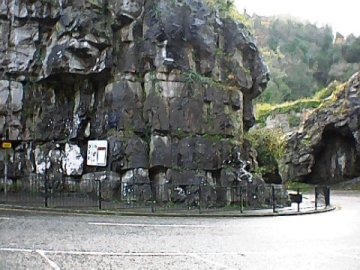
Cheddar Gorge