GOLD
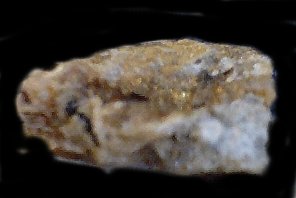
Gold in quartz
Crystals form as cubes or octahedra, but are rare. The usual habits are as grains, flakes, nuggets, and dendritic masses. The bright, rich yellow colour is resistant to tarnishing. Gold is often rich in silver, when it is paler in colour. It forms mainly in hydrothermal veins, often associated with quarz and sulphides. It also occurs in placer deposits of unconsolidated sand, and in sandstone and conglomerate. It is possible to find alluvial gold in grains or nuggets, in stream beds. Panning for gold by sifting the sediment is an age-old method of looking for this rare and valuable mineral. Gold can be confused with pyrite and chalcopyrite at first, but only a few tests are needed to identify it.
The colour of gold depends upon the amount and type of impurities it contains. Native gold is typically golden yellow, but in order to vary its colour and increase its hardness for use in jewellery, gold may be alloyed to other metals. Silver, platinum, nickel or zinc may be added to give a pale or white gold. Copper is added for red or pink gold; iron for a tinge of blue. Gold purity is defined by the proportion of pure gold metal present, and this is expressed as its carat value. The purity of gold used in jewellery varies from 9 carat (37.5 per cent or more pure gold), through 14, 18 and 22 carat, to 24 caratm, which is pure gold. In many countries, gold is "hallmarked" to indicate its degree of purity.
The main gold-bearing rocks occur in Africa, California and Alaska, Canada, the former USSR, South America and Australia.
Hardness: 2.5 - 3 Other characteristics
Metaphysical properties: Physical: confidence. General: Generosity. Assists: Partnerships